A clinician's guide to recommending a mood-tracking app: what to check first, how to set up between-session monitoring, how to review the data in session, and where apps fall short.
To choose a mood-tracking app for a client, check five things in order: who makes it and whether it is maintained, where the data goes, what evidence it rests on, whether your client will actually use it, and how the data reaches your session. Then keep the monitoring small, agree a purpose, and review it together. An app is a recording tool, not a treatment.
In short
Work through the questions in the order a framework would. The American Psychiatric Association's App Evaluation Model moves from background and access to privacy and security, clinical foundation, usability, and finally whether the app supports your therapeutic goals. It is meant to support an informed decision with your client, not to produce a pass or fail score.
The model grew out of a hierarchical framework for shared decision-making about apps. Its ordering is the useful part: an app with a beautiful interface but unclear data practices fails early, before you weigh its features. If you want a starting list of candidates, the M-Health Index and Navigation Database (MIND) describes hundreds of apps against objective questions derived from the same model.
The table turns those levels into concrete checks. The right-hand column shows how one app, Moodflow, answers them; the same column can be filled in for any app you are considering.
| Criterion | What to check | Red flag | Worked example: Moodflow |
|---|---|---|---|
| Maintenance | Last update, who is responsible, a working contact | No update for six to twelve months | Updated in 2026; developer and contact named in the privacy policy |
| Cost to the client | What is free, what needs a subscription | Core recording or export behind a paywall | Check-ins, reminders and the clinical summary PDF are free |
| Where data lives | On the device, in the developer's cloud, or both | Account required; data in the developer's cloud by default | On the phone; optional backup to the client's own Google Drive |
| Third parties | Advertising and analytics SDKs, data sale | Ads, advertising IDs, vague "partners" | No ads or usage analytics; anonymous crash reports |
| Clinical foundation | What the app claims and what it rests on | Efficacy claims without a trial of the app | No efficacy claims; not tested in a trial |
| Measures | Single ratings, validated scales, or both | A home-made score presented as diagnostic | Five-point rating and symptom severity; no validated scales |
| Safety | What happens when a client writes about risk | Implies someone is monitoring | No monitoring or alerts; states it is not an emergency service |
| Getting data to you | Export, print, share selected entries | No export, or export only through a paid portal | Clinical summary PDF with privacy-forward defaults |
| Fit | Languages, platforms, accessibility, effort | One platform only; long daily forms | iPhone, Apple Watch, Android; seven languages; one-tap check-in |
Assume nothing about privacy until you have read the policy. In a study of 36 top-ranked apps for depression and smoking cessation, 33 transmitted data to third parties, 29 of them to Google or Facebook, and many did not disclose it. Look for where entries are stored, whether an account is required, which third parties receive data, and whether the client can export and delete everything.
In the United States, an app that your client chooses and uses for themselves is generally not acting on your behalf. The HHS scenarios on health apps and HIPAA describe a provider who recommends an app that the patient then downloads and uses: the developer is not a business associate in that case. That does not make the app safe; it means HIPAA does not cover it. Once the client sends you an export, that document is part of your records.
The APA's revised Guidelines for the Practice of Telepsychology ask psychologists to explain to clients how digital tools, including mobile apps, store and handle their data. A short conversation is enough: where entries are stored, who else can see them, and that you will see only what the client chooses to share.
The evidence supports reviewing data with the client more than collecting it. Measurement-based care helps when results are fed back and discussed in the session. Mood monitoring alone has not shown a clear effect on symptoms in randomized trials. No consumer app inherits the evidence for the practice it supports, so ask what has been tested.
A review of measurement-based care in behavioral health defines four parts: routine measurement, the practitioner reviewing the data, the patient reviewing it, and the plan being reconsidered together in the session. It also found that fewer than one in five practitioners use measurement-based care. Fortney and colleagues found that frequent, timely feedback to providers improved outcomes in nearly all trials, while one-off screening and feedback outside the clinical encounter did not.
Across 58 studies, a multilevel meta-analysis of progress feedback found a small average benefit on symptoms (d = 0.15) and fewer dropouts. That is a modest effect from structured measures used inside care, not from a diary on its own.
In CBT, self-monitoring is part of the method. Cohen and colleagues describe it as a way to practise collaborative empiricism: client and therapist gather data, look at it together and test ideas against it. A meta-analysis of homework compliance across 17 studies found that completing more between-session work was associated with better outcomes.
Mood monitoring as a standalone intervention is a different question. A 2026 meta-analysis of eight randomized trials with 1,230 participants found that mood monitoring did not clearly increase or decrease symptoms in bipolar disorder, and found no robust effect in unipolar depression. The authors call for research into when monitoring helps.
It can for some people, and the size of the risk is uncertain. Reviews find burden, stress or worsening mood in a small number of mood-monitoring users, but most studies never measured adverse events. Watch for tracking that turns into checking, rumination or self-criticism, and agree in advance when the client should pause.
A 2025 systematic review and meta-analysis of 77 studies found that fewer than one in five studies reported adverse events at all, and very few used validated measures for them. Where they were reported, burden and subjective worsening of mood affected a small proportion of users, and the authors could not say whether monitoring caused them. Most participants found monitoring helpful.
In practice, this argues for small, purposeful tracking and a clear stopping rule. Ask about the experience of tracking at each review, not only the numbers. "What was it like to rate your mood every evening?" often tells you more than the average.
Use both, for different jobs. A validated questionnaire such as the PHQ-9 gives a comparable score with known properties. A daily mood rating shows fluctuation, timing and context between sessions. Neither replaces the other, and a self-made rating cannot be converted into a clinical score by averaging it.
The PHQ-9 was validated with specific items, a two-week time frame and cut-offs; a score of 10 or more had a sensitivity and specificity of 88% for major depression in the original study. A one-to-five evening rating has none of those properties. It is useful for questions such as "are Mondays harder?" or "does mood dip after short nights?", which a fortnightly score cannot answer.
If you use formal measures, give them as you normally would and treat the app's data as context. Ask the client what their own scale means to them, because "3" can mean "fine" to one person and "struggling" to another.
Keep it small and purposeful. Agree a question you want answered, choose one daily rating and at most two extra fields, set one reminder, and decide what the client will bring to the next session. Agree in advance what happens if tracking becomes a burden or makes things worse.
Missed days are data too. A gap often marks a hard week or a busy one, and both are worth asking about. Make it clear that an incomplete record is welcome. A client who fears your judgement may fill in days from memory, which makes the record less useful.
Some clients prefer paper. Our printable mood journal works as a fourteen-day sheet, and the same review questions apply.
Review it early in the session, with the client leading. Ask what they notice first, then look at one pattern and one exception together. Treat everything as a hypothesis to test, not a finding, and connect it to the goal you agreed. Ten minutes is usually enough.
A simple sequence works for most clients:
Be careful with correlations. A pattern such as "lower mood on workdays" is an association in a small sample of one person's days. It may reflect the job, the commute, sleep before workdays or simply which days the client remembered to log. Use it to choose what to explore, not to conclude.
This example is fictional. A client in their thirties agrees to rate their mood each evening for three weeks and to add sleep. Their summary shows 17 of 21 days logged, a median of 3, and two low stretches of two days each, both after nights under six hours. They notice the sleep link themselves. The therapist asks about the four missing days: they were the client's hardest. The next three weeks focus on evening routines, and the client drops the sleep field because it began to feel like a test.
Assume the app will do nothing. Most mood trackers do not detect risk or alert anyone, and nobody reads the entries. Make sure your client has a crisis plan with local emergency and helpline numbers that does not depend on the app, and tell them clearly not to use a diary entry to ask for help.
If an app offers crisis resources, check them. A systematic assessment of 69 depression and suicide-prevention apps found that only a small minority offered all the safety strategies recommended in clinical guidelines, and six listed an incorrect crisis helpline number, including two apps downloaded more than a million times each.
Be explicit about monitoring. Clients sometimes assume that writing in an app their therapist suggested means the therapist will see it. Say plainly who sees what and when.
Hold off, or agree a tighter plan, when tracking could harm or when the client needs more than a diary. That includes clients at acute risk, clients for whom recording turns into checking or self-criticism, clients without reliable access to a smartphone, and settings that require data to sit inside your own records system.
Health-care professionals in a 2026 systematic review and thematic synthesis of 15 studies with 604 professionals saw digital tools as a way to widen access, but kept raising concerns about therapeutic quality, risk management and extra workload. Those concerns are a good filter for individual clients too: if the app adds risk or work without serving a goal, leave it out.
Probably not for long without a reason. Real-world engagement with mental-health apps drops steeply within days. Recommendation from a clinician and a clear purpose are among the factors linked to better engagement, so agree what the tracking is for and review it at the next session.
A panel study of 93 Android mental-health apps found a median 15-day retention of 3.9% and a 30-day retention of 3.3% among people who installed them on their own. Clinician-recommended use with regular review is a different situation, but the drop-off is a reminder to plan for a short, defined period. A systematic review of barriers and facilitators of engagement lists, among others, poor fit, technical problems and privacy concerns as barriers, and social support, including a recommendation from the person's own provider, as a facilitator.
Plan for two to four weeks at a time. A defined block with a review at the end is easier to sustain than an open-ended request.
Moodflow is a mood diary for iPhone, Apple Watch and Android. Against the criteria above, it is strong on privacy, cost and getting data to the session, and limited on clinical features: there is no clinician portal, no validated questionnaire, no risk monitoring and no clinical trial of the app. The details below were checked against the app.
What the client records. A check-in is a one-tap rating on a five-point scale, from the app, a widget or an Apple Watch. Optional fields include emotions, activities, people, sleep and restedness, symptoms with severity, medications with dose, energy, stress and focus, and a note. Sections can be switched off, so a client can track only the rating and one or two items.
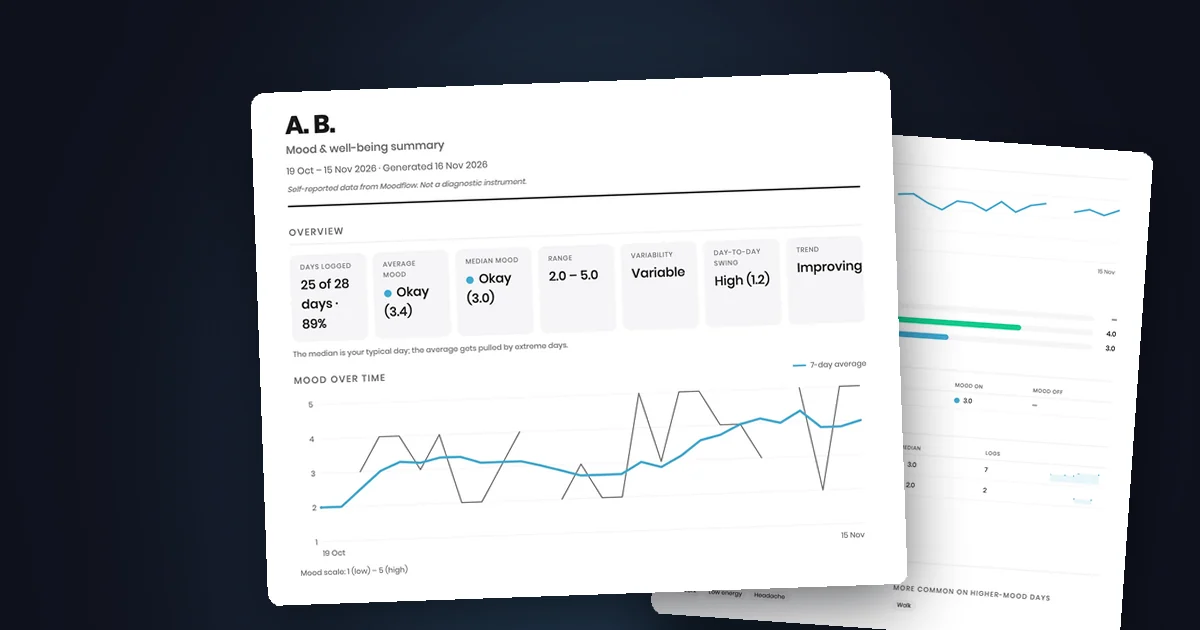
What arrives in the session. In Settings › Privacy & data › Export as PDF, the client can choose a clinical summary. It is free for any date range. It shows days logged, average and median mood, range, variability, day-to-day swing, trend, a mood chart with a seven-day average, a mood calendar and low-mood stretches. Sleep, medications, symptoms and patterns can be included, each labelled as associations rather than causes. Journal notes and full entries are off unless the client adds them, and the first page states that the data is self-reported and not a diagnostic instrument.
Privacy. Entries are stored on the phone and no account is needed. Backups are optional, either as a file on the phone or in a hidden app folder of the client's own Google Drive, where the copy is not separately encrypted by Moodflow. There are no ads or usage analytics. An optional AI companion, Flowy, is part of the paid Moodflow Plus subscription and sends a statistical summary and the client's questions to Anthropic only after consent; journal text, notes, photos, names, medications and imported health data are excluded. More detail is on our page for therapists.
What it does not do. It has no clinician dashboard or alerts, no PHQ-9 or GAD-7, no business associate agreement, and it is not a medical device. In Germany, it is not listed in the BfArM directory of prescribable digital health applications (DiGA), which are assessed for data protection and a positive healthcare effect.
If your client is preparing for therapy for the first time, our guide on what to track before therapy is written for them.
Choose the app that passes your privacy check, is free or affordable for the client, exports data in a form you can review, and fits how the client lives. No single app suits everyone. Run the same criteria for each candidate, and involve the client in the decision.
No, and it is often better not to promise it. Measurement-based care works through review in the session. If you do not monitor entries between sessions, tell the client so they do not expect a response, and make sure they have a separate crisis plan.
Agree a defined block, often two to four weeks, with a review at the end. Then decide together whether to continue, change what is tracked or stop. Open-ended tracking without a purpose tends to fade or become a chore.
Usually not, if your client chooses it and uses it for themselves. HIPAA applies to covered entities and their business associates, and HHS has described patient-chosen apps as outside that relationship. Check the app's privacy policy, and treat any export the client sends you as part of your records.
Editorial note: These are educational guides, not medically reviewed treatment advice. Templates and fictional examples are editorial tools, not validated diagnostic instruments. Research findings do not establish the effectiveness of Moodflow. Original source titles are retained below.
Sources and further reading

Moodflow Editorial
Practical guides to mood tracking and journaling from the Moodflow team.
Keep reading

Prepare for therapy or a mental-health appointment with a few useful notes: examples, daily-life impact, questions, and what you hope will change.

Download a free sleep diary PDF and learn what to record, how sleep relates to mood, and when insomnia or daytime sleepiness needs assessment.

A practical daily diary for premenstrual mood changes, including timing, symptom-free days, daily-life impact, and questions for a clinician.

A daily mood tracker journal with a free printable PDF, practical examples, and research on what tracking can and cannot tell you.
Track your mood in one tap and see what actually helps. Free on iPhone, Apple Watch and Android.